Monday, November 25, 2019

Haanji, gulab jamun ki sabji banti hai.


Gulab jamun. Those fried dough balls dipped in the super sweet chashni are just to die for. Some enjoy this delicacy with ice cream, others with rabri, and some as it is. But have you ever wondered how gulab jamun would taste in a sabji? Difficult to imagine, isn’t it? But a dish in Rajasthan does this job for you! The Gulab Jamun ki sabji from Jodhpur is an absolutely delicious and unusual take on this sweet, and adds a new dimension of flavours to it.
A savoury gulab jamun, with a rich gravy, this dish is quite popular in the Jodhpur region. It is one of the most delicious vegetarian Rajasthani delicacies.

Image result for gulab jamun ki sabji

The Gulab jamun balls are made with khoya and maida. Sometimes, to add a more savoury flavor, paneer is used.  To add some richness and typical Rajasthani flavor, sometimes rose water is added too. Like the usual gulab jamun, these are then fried till golden brown. These are not dipped in the sugar syrup (chashni).
The gravy is actually a typical yogurt-based gravy. The special thing about this recipe is the use of desi ghee, which makes it extra yummy and adds a special desi touch to it. The main ingredients in the gravy include onions, ginger garlic paste and curd. The spices are the usual cumin, red chilli, dhaniya, haldi, garam masala, lemon juice and some fresh coriander leaves as a garnish. If you like the tangy tomato, then you can add some tomato puree too. The spices, along with some maida are typically whisked into dahi.

There are a lot of variations in this recipe. Some like the usual yogurt curry, others like the tomato-onion gravy, and some like cashew gravy, which is quite rich. So it depends on you which one you like, and you can accordingly use that one.
This dish is closest to kofta perhaps, but it has khoya and so it is richer. These balls are still slightly sweet. The Gulab Jamun ki sabji is a great way to experiment with gulab jamun. It will definitely add a new take on this dish. So enjoy this lovely dish soon!

Butter Chicken ki kahani


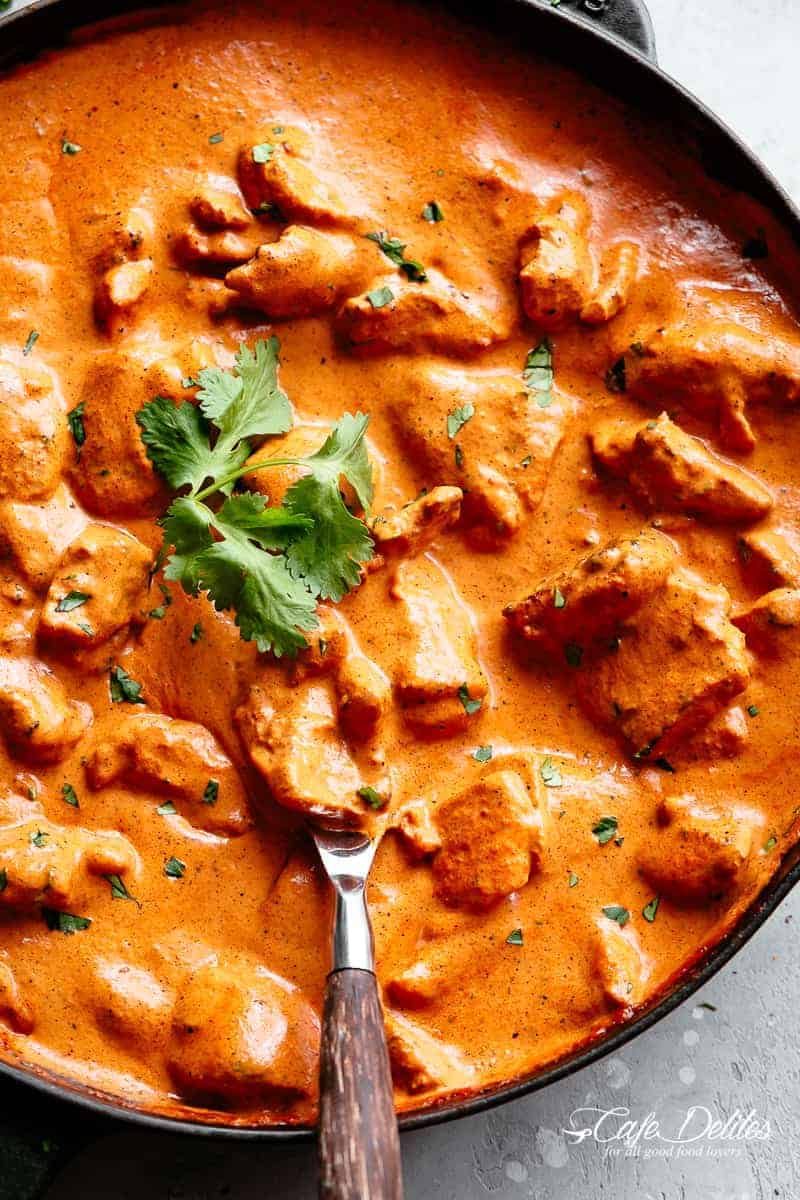
Butter chicken. Buttery, creamy, a bit tangy at times, with the right mix of spices, served with succulent and soft pieces of chicken. I absolutely love it. Don’t you? But have you ever wondered where it even came from?

Image result for butter chicken

Butter chicken was born in Old Delhi around the 1950s. Tandoori food and kebabs were highly popular in Delhi at this time. The succulent chicken and mutton kebabs, marinated in a unique blend of spices, and cooked to perfection, were savored by almost every single person from Delhi. The marinate of these kebabs was a mixture of spices like garam masala,jeera, coriander, chilli powder, tej patta, salt and pepper. This mixture of spices was rich in flavor and gave these kebabs their strong flavor.
One fine day, a restaurant owner decided to mix the leftover flavourful marinade with some tomato puree and loads of butter and cream. Hence our dearest, most favourite butter chicken was born. It was eaten either with naan or the paper-thin roomali roti. The owner didn’t know that he had invented what is arguably the most well-known Indian dish over the globe.

Now, the chicken is marinated in lemon juice, dahi, and spices which also include the ginger-garlic paste. The chicken was earlier cooked in a tandoor, like a kebab, but now it may be grilled, roasted or even pan fried. The gravy is a mixture of tomato puree which is spiced and cream and butter are also added. The gravy is simmered until smooth and until much of the water has evaporated. Sometimes, kaju paste is also used to thicken the gravy. The spices of the dish vary with the region.
Butter chicken may have been born in Old Delhi, but now it is a dish that India and the whole world loves. It is almost impossible to imagine a life without butter chicken. Butter chicken is everything we Indians love, butter, cream, chicken and fat. Kudos to this lovely dish!

Monday, October 28, 2019

Me-cut


As I came out of the salon, I was shocked. My stunning, silky shoulder brown length hair were all chopped off. And I was left with a ‘boy cut’ and some curly strands, which lingered over my forehead.
I had told the barber was just told to trim them, but he did this. And now when I look back, I realize how thankful I am to him.

From the next day, a new journey began. Many people, my close friends, some of my teachers and my parents loved the haircut. They said it made me look really smart.
But others had negative comments.
“Oh you look like a boy!”
“You looked so much better in your long hair!”
“They’ll grow back soon, right?”
“Poor girl, don’t worry, you’ll look pretty once they grow back!”
All these comments hit me harder than the positive ones. My confidence really went down initially. I couldn’t peacefully go for evening walks, or even to school. All those comments seemed cruel, and affected my confidence in myself.
But with time, it all changed.
I realized how important it is to believe in yourself.
It has been two years since I got this haircut, but I learn something new from it every single day. I never thought that something as simple as a haircut would teach me so much. The comments, the mocking used to really trouble me earlier, but with time my resilience has fought back. For me, it has never been a haircut. It’s a symbol to represent myself. And it’s a symbol for everything I stand for. Keeping this haircut for such a long time has taught me to fight. It gives me willpower to stand up for myself. Now, when I get those glares, those comments, I just smile. For I don’t care anymore. Infact, all those comments and mocks make me stronger. They give me the boost to stay the person I am, and keep believing in myself. The society wants me to be how they please, but I have learnt over time that its about you. Its about being the you who pleases you, and standing up and fighting for that You.
I am not a rebel, I am just another girl who wants to be herself.
I am not a girl with a ‘boy-cut’, for haircuts don’t have genders. I am just a girl with a ‘me-cut’.  I realize now that those tiny strands that linger over my forehead aren’t strands of hair. They are strands of every little ideal I stand for. They are strands of me. And nobody can grow or cut them. Except me.


Tuesday, October 22, 2019

Mystory


The clinking sound of footsteps on the iron staircase echoed in my ears, but the sound of my excitement persisted. Those eager murmurs on the first day of third grade made it even louder. A new class, new teacher, new friends, and most importantly, new subjects! Third grade was the first year we got to study History & Civics and Geography.

Before third grade, history had been all about watching TV shows about Jhansi ki Rani or Chandragupta Maurya, with the extravagant sets, sharp swords, powerful dialogues and glorious fights. And the whole idea of studying more about these legends made me very enthusiastic. I knew I wouldn’t just read about them, but my imagination would take me to them, sometimes clad in the same saree as Lakshmibai, other times as Queen Victoria perhaps.

Miss Kelkar walked into the class. Her jet black, long hair was tied elegantly into a lot plait. Her simple blue and purple salwar-kameez complemented her deep brown eyes and little black bindi perfectly. She came in, introduced herself, and told us to remove our history textbooks. I opened my textbook to the first chapter, and it was called ‘What is history?’. We learned basic terms like historian, archaeologist, inscriptions, emperors, etc. And then began a journey back in time, a journey to the past, which I live in the present.

I travelled to so many lands in that one year. Colonial India, Ashoka’s peaceful empire, Shah Jahan’s , stunning Taj Mahal site, all were covered in one year itself. 

Image result for watercolor painting indian history

Further, I came a veteran traveller to the lands of the past. I bathed in the Great Bath, sat in Tutankhamun’s court, traded along the Silk Route, and even saw the Code of Hammurabi right before my eyes. I attended a session in the diwan-e-aam, walked in the Dandi March with Gandhi, heard Nehru’s Tryst with destiny and even saw the bloody partition of my nation.

I have come a long way from words like historian, archaeologist, inscriptions and emperors. Words such as power, perspective, revolution and society have become a more significant part of history for me.
Image result for doodle on history

History evolves. Just like we all do. History also has a future. A future of the past, a future of the rich customs, traditions and culture of the past. We need to revive that past. We need to learn from it. We need to put it into current perspective to understand contemporary issues. The true essence of history isn’t the extravagant palaces or fancy costumes of the past. It is the rather lessons. Lessons from past mistakes, from the rich societies of the past, from how we have become who we are today. History teaches us why some are rich, some poor, some unequally treated and some specially treated. Once we understand the ‘why’, we need to look for the ‘how’ and identify solutions to solve such loopholes in the society. Not just the Indian society, but each and every society in the world faces some or the other social, political or economic issue. I want to study history as a solution, as a source which explains the root cause of the issue.


I want to read the story of the dead and derive morals for the living.

Saturday, October 19, 2019

Poison


Stranded in the vast,
Ocean of thoughts,
I am.
The boat of acceptance glares at me.
Attracts me to its comfortable,
Well-supported self.
The relaxation of not trying,
Just accepting,
Attracts me.
But fear overtakes desire,
And turns into a state of fascination,
As I see the thin white paper boat on my left.
Not strong enough to bear the ocean currents alone,
It strives to float somehow.
For its willpower is strong enough to stay there.
I swim to it,
Mesmerized by its simplicity yet strong demeanour.
As I lift it,
I see two golden words written there,
‘Be yourself’,
It says.
And it talks to me.
“Run away from the boat of acceptance,
For it will gulp your uniqueness.
Run behind who you strive to be,
Not who others want you to be.
Be the golden sunlight,
Or the dancing daffodils,
Be the fresh blue sky,
Or the grey clouds.
Be who you want to be.
Embrace your soul,
And don’t let the poison of acceptance contaminate your pure self.”

And since that day on,
I am me,
Uncontaminated by the comfortable acceptance.

Wednesday, October 2, 2019

His Shadow?


Today, 2nd October, 2019, we celebrate the 150th birth anniversary of Gandhiji. But we often forget one very important person. I would like to dedicate this day and this poem to her:

His white dhoti shines,
His serene eyes talk.
Is he a vision or is he true?
I see him cleaning his spectacles,
And caressing his charkha.
Gandhi is just a name,
He is a symbol,
A symbol of hope,
Of peace,
Of truth.
But who is she?
That pillar of support merely?
Her white saree,
Her strong demeanour,
Her fierce eyes,
All talk to me.
The woman who walked with him,
Who knew all his flaws,
His known,
His hidden,
His soul,
His heart
Evaporates.
Forms his shadow.
She chose so.
She was his strength,
But above all,
She was her strength.
She was his support,
But we all forget,
The support she gave herself.
She doesn’t hide behind him,
She is him.
And she chose so.
She chose to be empowered.
And self-enlightened.

Tuesday, September 17, 2019

Modak Chronicles


Modak! Round from the bottom and folded perfectly from the top, the modak is a lip-smacking sweet from Maharashtra. As Ganesh Chaturthi recently got over, I thought of writing a bit about why Ganpati bappa loved modak so much.
Image result for ukdiche modak

Firstly, a bit about the history of modak. The traditional modak is the ukdiche modak which is a steamed version of the modak. It has a filling of jaggery (gud) and coconut (nariyal). This filling is wrapped in rice flour and steamed. The modak is usually eaten with tup or ghee.  The three main ingredients of modak – jaggery, coconut and rice flour are local ingredients of Maharashtra. Hence, the modak started in Maharashtra. It is said to have been popularized from Shivaji’s period, when the Kasba Ganpati became the gram devta of Pune.
Now, why is modak associated with Ganpati?
Image result for ukdiche modak
Here, we turn to mythology. Modak is mentioned in two folklores:
       1)    Shiv and Parvati were invited to a lunch by Anusuya (a rishi’s wife). The dutiful hostess served lots of food to the family. There was so much variety, food from different regions, with different textures and numerous flavours. But Ganesh remained hungry. He kept on eating all he was given, but his hunger was not satisfied. Finally, Anusuya thought of something sweet and brought some modaks for Ganesh. They finally satisfied his hunger. And after eating them, he burped 21 times. That’s why 21 modaks are offered to Ganesh.
2     2)  The devtas once came to visit Shiv and Parvati and presented them with a divine modak. The person who ate it would become knowledgeable in all shastras. Parvati wanted to present it to her sons. But they weren’t ready to share it. Hence, Parvati asked them to prove their sincerity and devotion. Karthikey, Ganesh’s brother mounted on his vahana and travelled to all three worlds, but Ganesh just went around Shiv and Parvati, to show his devotion towards them. Hence, Parvati gave him the modak. Here, the modak acts as a symbol of Ganesh’s dedication towards his parents are well as a representation of knowledge, wisdom and sincerity.
Image result for ganesh with modak
Modak isn’t just a dish, it a symbol of all that Lord Ganesh stands for: knowledge, wisdom and divinity.

Perks of being alone

Solitude. They call it. Self discovery. I call it. My parents are on a trip to Thailand. Honestly, I thought I’d just sit at hom...